
If a staff-augmented developer isn’t performing the way you expected, you’re probably asking the wrong question first. Most managers jump straight to “we got the wrong person,” ask their talent partner to swap them out and hit the same wall six months later. The uncomfortable truth: most underperformance on an augmented team isn’t a talent problem. It’s a process problem to wear a people costume, and because staff augmentation puts you in the driver’s seat, that process lives with you, not your talent partner.
Why “It’s the Person” Is Rarely the Full Story
When sprints slip and communication feels like pulling teeth, it’s tempting to blame the developer on your team. But requesting a replacement without diagnosing the root cause is expensive and slow and the same management gaps tend to resurface with the next hire, too. Unlike a managed outsourcing arrangement, staff augmentation means you own delivery, scope and process. Your talent partner’s job is to source and administer the person; running the work is on you.
Before assuming it’s a skills issue, ask:
● Did we hand over a clear, written scope or a Slack message and a prayer?
● Is there a defined intake process for new requests and changes?
● Is there a single point of accountability on our side for this hire?
● Are we measuring output against agreed milestones, or just vibes?
Mostly “no”? You likely have a process gap, not a people gap.
A Quick Way to Diagnose the Real Problem
Use this walkthrough with your team this week to separate symptoms from root causes.
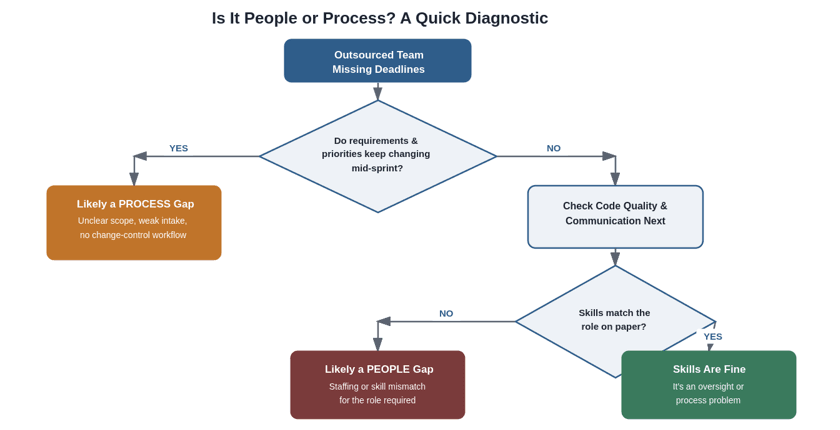
Most real engagements have a mix of both, but one usually dominates.
People Problems vs. Process Problems
| Symptom | Usually People | Usually Process |
| Missed deadlines | Overcommitted, lacks seniority | No shared “done” scope keeps shifting |
| Buggy releases | Skill gap with the stack | No code review or QA standard agreed with the client |
| Poor communication | Language/style mismatch | No meeting cadence, no shared docs |
| Slow onboarding | Wrong hire for the role | No onboarding checklist or access plan |
| Constant rework | Misreads requirements repeatedly | No sign-off step before dev starts |
| Unexpected turnover | Individual attrition risk | No retention or continuity terms with the talent partner |
If most pain points sit in the right column, replacing the person won’t fix it. You need a better internal management process: documented handoffs, one source of truth and clear escalation paths on your side of the table.
Why Staff-Augmented Developer Teams Struggle: The Time-Zone Factor
Companies working with augmented talent abroad often hit a specific failure pattern: time-zone-driven communication gaps stacked on vague, undocumented scope. When a U.S. product owner and an augmented developer overlap for only a few hours a day, ambiguity compounds overnight rather than resolving in five minutes. This is a leading and fixable reason performance stalls, not a lack of talent abroad, but a lack of structure at home.
Perpetum’s core talent hub is Bulgaria, part of the broader Eastern European talent market we draw on. Here’s how the overlap compares:
| Region | Time Zone | Overlap with U.S. Eastern Time |
| Bulgaria (Perpetum’s core talent hub) | EET (UTC+2/+3) | Roughly 2–3 hours of live morning overlap is enough for a focused daily sync, with the rest of the day running async on a clear, documented scope. |
| Rest of Eastern Europe (Poland, Romania, Serbia, Ukraine) | CET/EET (UTC+1 to +3) | Similar 2–4-hour morning overlap, comparable working culture and skill depth to Bulgaria, and part of the same broader Eastern European talent pool Perpetum draws from. |
| India / Colombia | IST / COT | India offers minimal daytime overlap; Colombia’s COT (UTC−5) gives a near full-day overlap with U.S. Eastern Time a genuine scheduling advantage, though outside Perpetum’s core Eastern European focus. |
The fix isn’t chasing full-day overlap for its own sake. It’s tightening your process: async documentation standards, recorded decisions and a narrow daily overlap window reserved for blockers. That structure is what lets Bulgarian and wider Eastern European talent deep in engineering skill, strong in English and culturally aligned with U.S. and Western European teams, outperform a “convenient time zone” hire with none of it.
For context on the U.S. software labor market when benchmarking rates or team size, see the BLS Occupational Outlook Handbook: Software Developers, which projects developer employment to grow much faster than average through 2034.
The Fixable Process Checklist
Run through this before asking your talent partner for a replacement:
● Written scope of work with acceptance criteria for every deliverable.
● One communication channel for decisions, not scattered across apps.
● A defined sprint or milestone cadence, reviewed on schedule.
● Code review and QA gates before anything ships.
A worker classification review: with a direct hire or contractor, misclassification creates real legal and tax exposure. This is exactly what an Employer of Record (EOR) model is built to remove; see our EOR explainer for how Perpetum keeps a Bulgaria-based hire fully compliant. For general background, the SBA’s Hire and Manage Employees guide is a useful primer.
Secure development practices agreed with the developer; see NIST’s Secure Software Development Framework for baseline standards any engineer on your team should follow.
Checking most boxes already and problems persist? Then it’s more likely the person.
When It’s Actually the Person
Process fixes won’t save an engagement where the developer consistently can’t perform the work they were hired for, seniority promises don’t match delivered work or basic professionalism is missing. Here, a staffing change is genuinely needed, but pair it with a better process on your side or you’ll recreate the same problem with the next hire.
How to Decide, This Week
Pull out your last three sprints. For each miss, write one sentence: unclear scope or unclear skill? Tally the results; whichever category wins is your primary problem. Fix that one first; don’t overhaul both at once or you won’t know what worked.
Conclusion
An underperforming staff-augmented developer is a signal, not a final decision. Audit your own process first: scope, cadence, review gates, accountability before assuming the person is the issue. Most broken-feeling engagements are missing structure, not talent.
That’s also why the sourcing model matters. Perpetum isn’t a managed outsourcing shop; we don’t run your delivery or your process. We do one thing well: source and administer curated, near-zero-attrition Bulgarian and Eastern European talent, through EOR or staff augmentation, so you get the right person, fully compliant, while you keep full control of how the work gets run. Explore the difference between EOR and staff augmentation, or go straight to our staff augmentation page to see how a curated shortlist and near-zero attrition change the math on your next hire.