Picture this. A message lands in your HR channel that says: “Hey, have we looked at the EU Pay Transparency Directive?” If you hire anyone based in the EU, whether that’s one contractor in Lisbon, a five person team in Warsaw, or an entire remote org spread across the continent, that message is worth taking seriously. This is not a proposal sitting in draft somewhere. It is binding law and as of June 2026 it is live across all 27 member states.
Here is the good news. It is not as chaotic as it sounds once you separate the real obligations from the LinkedIn panic posting. Let’s walk through what changed, who it hits, and what to actually do about it.
So, What Is the EU Pay Transparency Directive?
The EU Pay Transparency Directive (formally Directive (EU) 2023/970) is EU wide legislation built to close the gender pay gap by making salary decisions visible instead of buried. The European Commission adopted it in 2023, gave member states three years to write it into national law and that clock ran out on 7 June 2026. Every EU country now has some version of this on its books, whether it wanted the deadline pressure or not.
The logic behind it is simple. Pay discrimination survives on secrecy. Take the secrecy away and it becomes much harder to justify why two people doing equivalent work land on wildly different salaries. According to the European Commission, the EU wide gender pay gap still sits above 11 percent and this directive is the mechanism meant to shrink it.
Who Actually Has to Comply
Here is where a lot of founders exhale too early, thinking “we’re small, this doesn’t apply to us.” That is only partly true. The heavier reporting obligations scale with company size, but a good chunk of the rules apply the moment you have even one person employed in the EU.
- Recruitment transparency applies to employers of any size hiring in the EU. This is the part that catches remote first startups off guard.
- Gender pay gap reporting kicks in at 100 or more employees, with heavier annual reporting starting at 250 or more.
- Non EU headquartered companies are in scope too, as long as they employ people physically based in an EU member state, including through an EOR, a local entity, or remote contracts.
In plain terms: if your five person engineering team in Bulgaria reports to a US parent company with zero EU presence otherwise, the recruitment side rules still apply to how you hire that team.
What Changes in How You Hire
This is the part most companies feel first, because it touches every job post. Under the EU Pay Transparency Directive, you can no longer post a role and stay quiet on pay until the final interview. Candidates must be told the starting salary or pay range before the interview stage, either in the listing itself or shared upfront. You also can’t ask what someone currently earns. That question, common as it has always been, is now off the table across the EU.
Job titles and postings need gender neutral language too, which sounds minor until your ATS templates need an audit. None of this asks you to become a different company overnight. It asks you to write down the pay logic you probably already follow and make it visible instead of implied. Here is a quick side by side of what actually shifts:
Salary Disclosure Compliance for Existing Employees
Once someone is on payroll, salary disclosure compliance does not stop at the offer letter. Employees can now formally request their own pay level and the average pay, broken down by gender, for people doing equal or comparable work. You have to answer and you can no longer enforce a pay secrecy clause that stops colleagues from comparing notes. If your contracts or handbooks still include a “do not discuss compensation” clause, treat it as dead weight in the EU now.
Reporting Deadlines and the 5 Percent Rule
For companies over the size threshold, gender pay gap reports go to a national authority and become publicly available, job candidates included. Here is how the timeline breaks down:
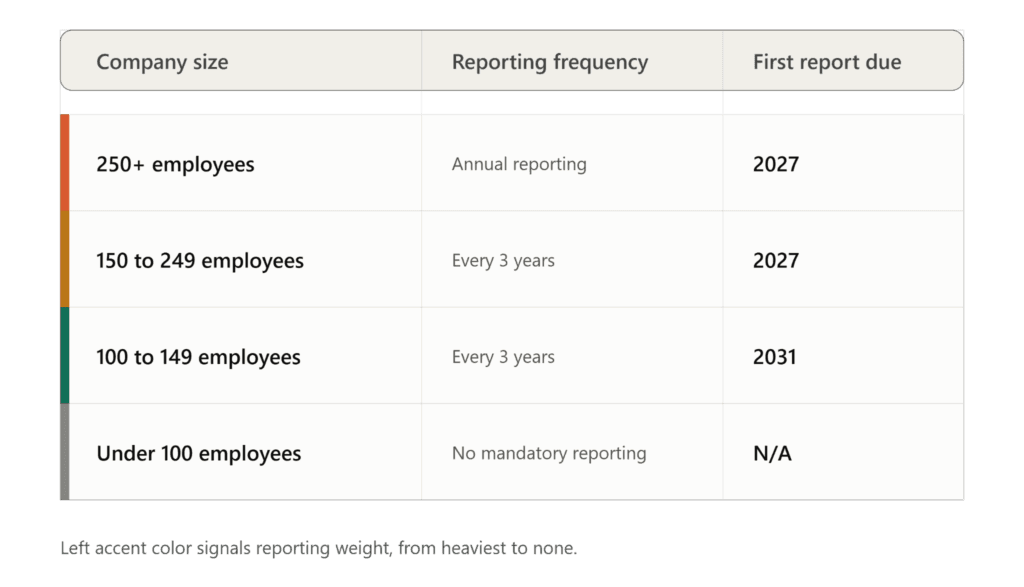
If a report shows an unexplained gap of 5 percent or more in any category, you get six months to fix it before a Joint Pay Assessment, done together with employee representatives, becomes mandatory. It is not designed to be punitive by default. It is designed to make ignoring the gap the more expensive option.
Understanding the Broader Pay Transparency Law Europe 2026 Shift
It is worth zooming out here, because this directive is not happening in isolation. The wider pay transparency law Europe 2026 landscape, including UK gender pay gap reporting and similar moves in parts of the US, points to a direction, not a one-off. Countries are converging on the same logic. If you can’t explain a pay gap with objective criteria, you will eventually have to close it.
Enforcement varies by country, but expect fines tied to turnover or payroll, uncapped compensation for affected employees and, this is the part that actually changes behaviour, a shifted burden of proof. Employers now have to prove they did not discriminate, not the other way around.
What This Means If You’re Hiring in Europe Right Now
If you are actively building or scaling a team across EU markets, here is a practical shortlist worth acting on before it turns into a scramble.
- Add real salary ranges to every EU job posting, not placeholder brackets.
- Strip salary history questions out of application forms and interview scripts.
- Document the objective criteria behind your pay bands, by role and level.
- Check whether your headcount in any single EU country is approaching the 100 employee reporting line.
None of this requires an overhaul. It requires the pay logic your company already runs on to be written down, consistent and ready to show.
Where Perpetum Fits Into All This
Compliance frameworks like this are exactly why most founders don’t want to hire directly in a country they have never operated in. Getting salary bands, contracts and reporting right across multiple EU jurisdictions is a full-time job on its own. That is the gap Perpetum exists to close. Whether you are hiring your first engineer in Bulgaria or scaling a distributed team across Eastern Europe, we build the compliant hiring infrastructure underneath it, so pay transparency becomes a solved problem instead of a standing risk on your books.
FAQs: