
Somewhere between “we need to ship faster” and “we can’t justify another Bay Area headcount,” most founders land on the same idea: what if the work never actually stopped? That’s the premise behind a 24-hour engineering team; not a call-center gimmick, but a real build-ship-fix loop that moves across Eastern Europe, Latin America, and India as the sun does. It looks clean on a slide. It’s messier in practice, and worth doing anyway once the handoffs are owned properly. Building a 24-hour engineering team isn’t just about hiring across time zones. It’s about choosing the right regional mix, designing effective handoffs, and avoiding the communication gaps that can slow everything down.
What a 24-Hour Engineering Team Actually Is
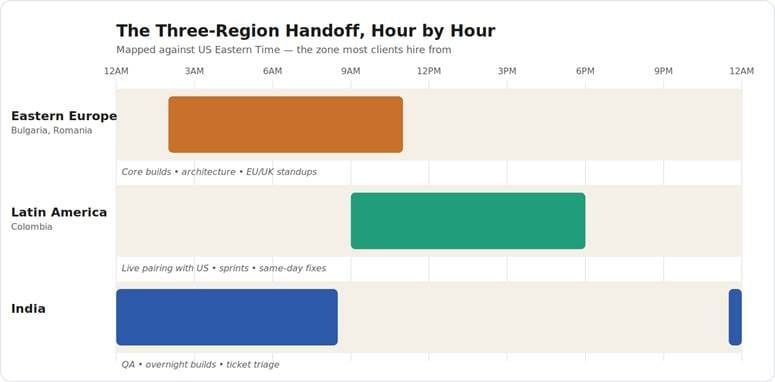
The idea isn’t new. Engineers at IBM were experimenting with round-the-globe code handoffs back in the 1990s, long before “distributed team” became a LinkedIn headline. The mechanic is simple: instead of one team clocking eight hours and going quiet, you place engineers in three time zones far enough apart that as one shift wraps, the next one is already reading the handoff notes. Done well, a ticket opened in Sofia at 4pm can be picked up in Bogotá before dinner and closed in Bangalore before the US East Coast has finished breakfast. Done badly, it’s three teams working in isolation who happen to share a Slack workspace.
This is what the relay actually looks like on a Tuesday; not as a spreadsheet, but as the clock it actually runs on.
Eastern Europe vs. LatAm vs. India: What Each Region Is Actually Good For
A 24-hour engineering team only works if you stop treating the three regions as interchangeable “offshore” labor and start assigning work to where it fits.
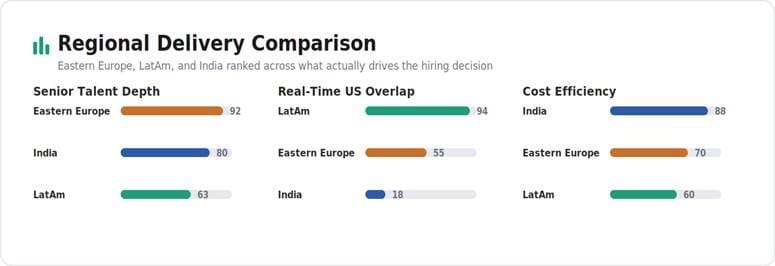
Worth checking the primary sources rather than taking a vendor’s word for it: the US Bureau of Labor Statistics tracks what US software engineers actually cost by metro, Eurostat publishes ICT labor data across Bulgaria, Romania, and Poland, and Invest India and ProColombia both maintain current figures on tech-sector talent pools in their respective countries, useful sanity checks before committing headcount budget to any single region.
The Parts Nobody Puts in the Pitch Deck
The handoff is where a 24-hour engineering team either compounds or collapses. IBM’s own early experiments are the cautionary tale here; one of their first globally distributed teams failed specifically because engineers weren’t handing off artifacts daily. The lesson held up for thirty years:
● Documentation discipline isn’t optional. If the outgoing shift can’t leave a handoff note a stranger could act on, the model is just three separate teams sharing a repo.
● Someone has to own the seam. Not a rotating duty, a named lead per region who’s accountable for what gets picked up, not just what gets pushed.
● Async tooling has to be genuinely async. A shared doc that only makes sense with context from a meeting nobody recorded isn’t a handoff; it’s a trap for the next shift.
● Cultural fit matters more at the seams than within a region. The friction shows up at 9am Sofia time, reading notes from someone in Bogota who assumed context that was never written down.
Is a 24-Hour Engineering Team Right for You Right Now?
Not every team needs one. A 24-hour engineering team earns its complexity when at least two of these are true for you:
● Your current dev team is stalled or under-delivering and a single-region hire won’t fix the velocity problem fast enough.
● You’re comparing EOR, staff augmentation, and direct hiring and keep landing on “we need people, not just a payroll wrapper.”
● Your product has global users, and a bug at 2am ET currently waits eight hours for someone to notice.
● You’re past the “scrappy five-person team” stage and need engineering coverage that doesn’t depend on one senior engineer’s sleep schedule.
Where This Leaves You
A 24-hour engineering team isn’t just about hiring developers in different time zones. It’s about making sure work moves smoothly from one team to the next. When teams in Eastern Europe, LatAm, and India communicate well and hand off tasks clearly, development can continue around the clock without overworking anyone. But if those handoffs aren’t managed properly, you end up with separate teams working in silos instead of one connected team.
This is the exact model Perpetum builds for clients every day: sourcing senior engineers out of Bulgaria, connecting them with vetted LatAm and India delivery hubs, and handling the EOR and compliance paperwork underneath so the only thing you’re managing is the work itself. If a stalled team or a coverage gap is the reason you’re reading this, that’s precisely the fire we’re built to put out.
FAQs