
Hiring the right talent is one of the biggest challenges every startup faces, but the hiring model you choose can matter more than who you hire. As startups expand beyond their home market, the decision between a Contractor and an Employer of Record (EOR) shapes everything from cash flow to legal exposure to how fast you can actually get someone working.
Contractors look cheap and fast at first glance. But the global EOR market is on track to nearly double from roughly $5.6–6.0 billion in 2025–2026 to over $10 billion by the early 2030s, a sign that a lot of companies are concluding contractor-only strategies don’t scale (Business Research Insights, 2026).
This guide walks through both models with real data: current market sizing, the actual Internal Revenue Service (IRS) and Department of Labor (DOL) penalty structure for misclassification, documented case examples, and a practical framework for deciding which model or mix of both, fits your startup right now. Every figure below is sourced; the links are at the end.
Why Startups Need the Right Hiring Model
Startups operate in a fast-moving environment where speed and flexibility are the whole game. But the hiring approach you pick affects more than how quickly you fill a role, it shapes legal compliance, employee experience, operational overhead, and how easily you can scale a team in a new country.
By mid-2024, 73% of companies had successfully grown their global workforce using EOR services, and compliance has become the number one reason companies reach for one: 86% of HR leaders now name international labor-law compliance as their top global workforce challenge (SelectSoftwareReviews, 2026; Slasify, 2026).
Picking the wrong model doesn’t just slow you down, it can trigger tax exposure, back-pay claims, or trouble closing your next funding round if an audit surfaces mid-diligence. That’s why comparing Contractor vs Employer of Record properly, before you scale, is worth the hour it takes to read this.
What Is an Independent Contractor?
An independent contractor is a self-employed professional who works with your company on a contract basis, usually for a defined project or period and handles their own taxes, benefits, insurance, and schedule.
Startups typically reach for contractors for:
• Short-term or project-based work
• Freelance or specialist assignments (design, dev sprints, consulting)
• Testing a role or market before committing long-term
• Flexible hiring without payroll infrastructure
Because contractors handle their own tax filing and benefits, your startup avoids most of the administrative load, which is exactly why contractor hiring is so common pre-Series A. But that flexibility rests on a legal line that’s easy to cross without noticing.
The classification tests that actually decide contractor status
Your contract’s wording doesn’t determine legal status, the working relationship does. Three different bodies apply three different tests, and a worker can pass one and fail another:
• IRS common-law test: behavioral control, financial control, and the nature of the relationship (see IRS Publication 15-A).
• U.S. DOL economic-reality test: under the current Fact Sheet #13 standard, reverted in 2025 to the traditional multi-factor test; a February 2026 proposed rule would keep this business-friendly framing (Foley & Lardner, 2026).
• State ABC tests: California, New Jersey, and Massachusetts presume employee status unless the business proves all three prongs of the ABC test.
A worker can be a legitimate contractor federally and still be reclassified as an employee under a state ABC test. That gap is where most startup misclassification exposure lives (SDO CPA, 2026; Foley & Lardner, 2026).
What Is an Employer of Record?
An Employer of Record (EOR) is a third-party organization that becomes the legal employer of a worker on your behalf. Your startup still directs the person’s day-to-day work; the EOR takes on the formal employment obligations:
• Payroll processing and payslips
• Tax withholding and filing
• Locally compliant employment contracts
• Statutory and supplemental benefits
• Local labor-law compliance and HR administration
Full-service EOR; the model that includes entity, contract, payroll, tax, and benefits, now makes up roughly 48% of the total EOR market, and businesses using it report cutting international hiring costs by 60–70% relative to setting up a foreign entity, while shrinking market-entry timelines from 6–12 months down to about one to two weeks (Custom Market Insights, 2026).
For startups planning international expansion, this is the core appeal: an EOR for startups removes the legal and administrative barriers of hiring abroad without the capital outlay of a foreign subsidiary.
Contractor vs Employer of Record: Key Differences
| Factor | Independent Contractor | Employer of Record |
| Employment status | Self-employed; no legal employment relationship | Legal employee of the EOR, working for your company day to day |
| Who runs payroll | Contractor invoices you directly; no withholding | EOR runs local payroll, tax withholding, and filings |
| Tax handling | Contractor pays self-employment tax (~15.3% in the US) | EOR manages employer and employee tax compliance |
| Benefits | Rarely included; contractor buys their own | Statutory and often supplemental benefits included |
| Compliance risk | Sits with your startup, including misclassification exposure | Shifts to the EOR, which carries local employment liability |
| Time to hire | Days, usually just a contract and an invoice | Typically 1–2 weeks once local entity setup (6–12 months) is skipped entirely |
| Typical cost | Lower sticker price, but 15–30% higher effective tax load falls on the worker | $400–$1,500 per employee/month depending on provider and country |
| Best for | Short-term, project-based, or highly specialized work | Long-term, full-time international hiring |
The Global EOR Market, By the Numbers
The scale of adoption is a useful sanity check on whether this is a genuine trend or a sales pitch. Market-sizing estimates vary by methodology, but they agree on direction and magnitude:

• North America holds the largest regional share, at roughly 41–45% of global EOR revenue.
• Asia-Pacific is the fastest-growing region, driven by tech-sector expansion into India, the Philippines, and Vietnam.
• Small and medium enterprises, including startups; already account for over 50% of global EOR clients and are growing at roughly 14–15% CAGR, nearly double the rate of large enterprises.
(SelectSoftwareReviews, 2026; Custom Market Insights, 2026; FMC Group, 2026)
The Real Cost of Getting It Wrong
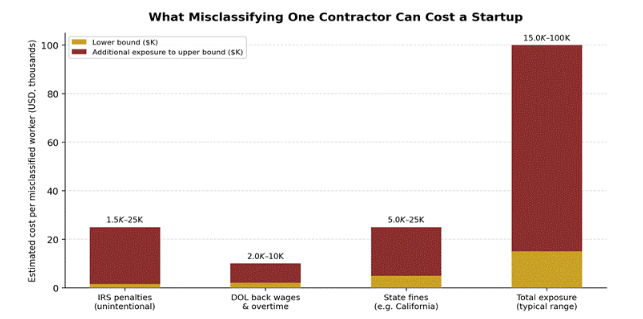
Misclassifying even one worker is more expensive than most founders expect, and enforcement doesn’t require intent, an honest mistake still carries penalties.
What the IRS and DOL actually charge
Under IRS Section 3509, unintentional misclassification typically triggers a $50 fine per unfiled Form W-2, 1.5% of wages for unwithheld income tax, and 40% of the employee’s unpaid FICA share plus the full 7.65% employer share. Willful violations remove those reduced rates entirely and add criminal fines up to $1,000 per worker, with possible personal liability for owners (Playroll, 2026).
Layer on DOL back-wage claims under the Fair Labor Standards Act and state penalties, California alone imposes $5,000–$25,000 per violation and the combined exposure for a single misclassified worker typically lands between $15,000 and $100,000+, scaling with how long the arrangement ran (Employee vs Contractor, 2026).
It’s not just a startup-scale problem
Nike faced potential tax exposure exceeding $530 million over alleged misclassification of temporary office workers, and FedEx settled a class action for $228 million after more than 2,000 drivers were found to be misclassified as contractors (Playroll, 2026). The pattern in both cases: a large group of workers, in similar roles, over several years; the exact shape most startups grow into once a “we’ll fix it later” contractor strategy scales past its first few hires.
When an Employer of Record Makes More Sense
An EOR earns its cost when a startup needs to hire internationally without opening a legal entity in every country it operates in.
Expanding Into New Markets
If you’re testing a market before committing capital, standing up a local company rarely makes sense. An EOR lets you hire compliantly in weeks instead of the 6–12 months entity registration typically takes.
Building a Dedicated Team
Employees hired through an EOR are integrated members of your organization, not arm’s-length vendors, which tends to improve collaboration, accountability, and retention over time.
Managing Employment Compliance
Employment law varies sharply by country. An EOR tracks local labor law and employment documentation on your behalf, which is precisely the risk surface this guide’s misclassification section covers.
Supporting Long-Term Growth
For startups planning sustained global hiring, an EOR is scalable infrastructure; it grows with you rather than requiring a new legal setup for every market you enter.
A Simple Startup Decision Framework
Use the checklist below to decide which model fits your current hiring need. If most of your answers land in the left column, a contractor is likely the better fit right now. If most land in the right column, an Employer of Record gives you a stronger long-term foundation.
| Lean Contractor if… | Lean Employer of Record if… |
| The engagement is project-based with a defined end date | You’re hiring for an ongoing, full-time role |
| The worker sets their own hours and methods | You need to direct day-to-day work and hours |
| You don’t need the person integrated into core operations | The role is core to the business and needs long-term retention |
| You’re hiring in a single, well-understood jurisdiction | You’re hiring in a country where you have no legal entity |
| You can tolerate re-evaluating the arrangement every few months | You want compliance risk managed by someone else |
The real answer to “how do I choose between a contractor and an Employer of Record for a startup” usually comes down to three variables: expected duration of the role, compliance exposure in that jurisdiction, and how central the role is to your long-term hiring plan.
Finding the Right Balance: The Hybrid Approach
Most successful startups don’t rely on one model exclusively. A common pattern:
• Contractors cover short-term development sprints, marketing campaigns, or specialist consulting.
• An EOR covers full-time engineers, sales, customer success, or operations roles in markets where you’re building a lasting presence.
This mirrors where the market itself is heading, IT and tech roles are projected to grow at roughly 15% CAGR in EOR spend, the fastest of any vertical, which tracks with how tech startups actually hire: contractors for burst capacity, EOR for the core team (FMC Group, 2026).
Common Mistakes to Avoid
Startups often assume contractors are automatically the cheapest option. Initial invoices may look lower, but misclassification penalties; as shown above, can dwarf whatever was saved on payroll admin.
Other recurring mistakes:
• Hiring international contractors without checking local labor law, a contract valid in the U.S. may not hold up in the EU or UK.
• Treating contractors like employees in practice: fixed hours, company equipment, ongoing supervision; the exact fact pattern the IRS and DOL tests flag.
• Delaying compliance planning until after you’ve already scaled a country’s headcount.
• Choosing the cheapest hiring option instead of the most legally defensible one for that specific role and jurisdiction.
Roughly up to 30% of U.S. employers have misclassified at least one worker, often without intent, which is exactly why proactive classification review, not just contract wording, is the real safeguard (Bluestone Law, 2026).
Conclusion
There’s no universal answer to Contractor vs Employer of Record; both models solve real problems, just different ones. If your startup needs flexibility for short-term or specialist work, contractors remain the faster, simpler option. If you’re building a long-term international team and want compliance risk carried by someone else, an EOR delivers more stability as you scale.
Whether you’re making your first international hire or expanding across a dozen countries, getting this decision right early avoids expensive corrections later. If you’re looking for a compliant, scalable global hiring solution, Perpetum can help simplify every step of the process.
FAQ
1. What is the difference between a contractor and an Employer of Record (EOR)?
2. When should a startup choose an Employer of Record?
3. Is hiring contractors cheaper than using an Employer of Record?
4. Can startups hire internationally without setting up a foreign entity?
5. Which hiring model is better for long-term business growth?
6. Are the classification rules changing in 2026?